
Guides
Chiller Van vs Freezer Van: Which One Does Your Cargo Need?
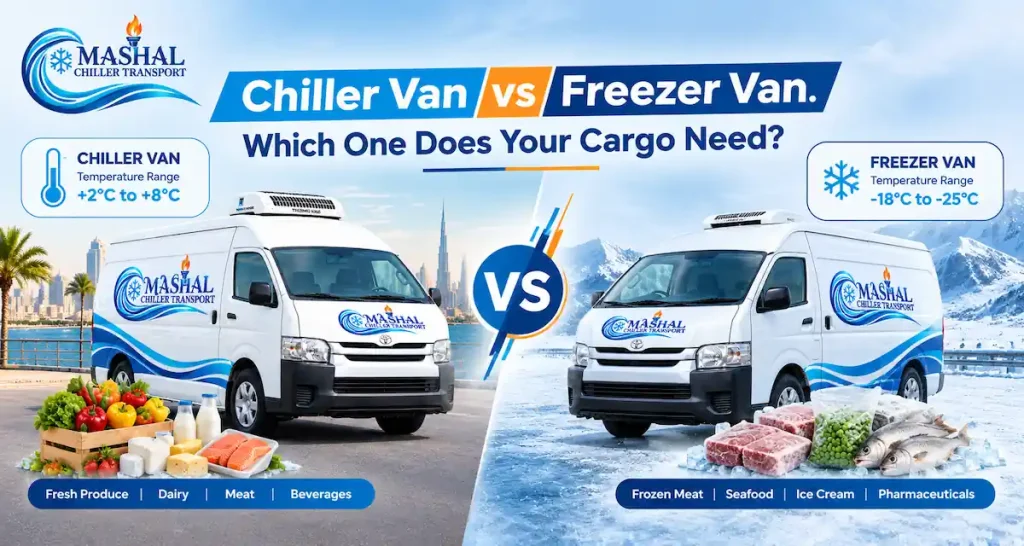
Every week someone messages our dispatch desk asking for “a chiller van” to move ice cream, or “a freezer van” for a load of fresh vegetables. Both requests would end badly. The two vehicles look almost identical from the outside — same Toyota Hiace body, same insulated box, same reefer unit on the roof — but they do opposite jobs. One keeps food cold. The other keeps it frozen.
This guide explains the difference in plain terms, shows which cargo belongs in which vehicle, and gives you four quick questions that settle the choice before you book.
Quick answer: choose a chiller van (0°C to +8°C) for anything labelled “keep refrigerated” — fresh produce, dairy, fresh meat, flowers and 2–8°C medicines. Choose a freezer van (−18°C to −25°C) for anything labelled “keep frozen” — ice cream, frozen meat and seafood, frozen ready meals. If one route carries both, ask for a partitioned vehicle with two compartments.
The one difference that matters: the temperature range
Everything else follows from the set range of the refrigeration unit.
- Chiller van — 0°C to +8°C. Holds food just above freezing, so it stays fresh without turning to ice. This is the range for chilled goods.
- Freezer van — −18°C to −25°C. Holds food frozen solid. −18°C is the widely used benchmark for frozen food, and the colder end of the range is there for products that need extra margin, such as ice cream.
The two ranges don’t overlap, and that is the point. A chiller van cannot keep frozen stock frozen — it will slowly thaw. A freezer van is the wrong home for fresh produce, dairy or flowers — they will freeze, and frozen lettuce or split yoghurt cannot be sold.
Chiller van vs freezer van at a glance
| Chiller van | Freezer van | |
|---|---|---|
| Temperature range | 0°C to +8°C | −18°C to −25°C |
| Job | Keeps cargo cold and fresh | Keeps cargo frozen solid |
| Typical cargo | Fruit and vegetables, dairy, fresh meat and fish, bakery, flowers, 2–8°C medicines | Ice cream, frozen meat and seafood, frozen vegetables and fries, frozen ready meals |
| Vehicle | Toyota Hiace | Toyota Hiace |
| Payload | 1–3 ton | 1–3 ton |
| Load volume | 6.0–6.5 m³ | 5.5–6.0 m³ (thicker insulation) |
| Daily rate | AED 250–450 | AED 250–450 |
| Monthly rate | AED 3,000–4,000 | AED 3,000–4,000 |
| Delivery | Free, all seven emirates | Free, all seven emirates |
Notice the load volume. A freezer box needs thicker insulation walls to hold −18°C and below in UAE heat, so it carries slightly less by volume than a chiller van of the same size. If your load is close to the limit, that half a cubic metre matters.
What belongs in a chiller van
- Fresh fruit and vegetables — supermarket and restaurant supply, market runs
- Dairy — milk, laban, yoghurt, cheese, cream
- Fresh meat, poultry and fish moving for same-day or next-day use
- Bakery and pastry — cakes, desserts, cream-filled items
- Flowers and plants for events, hotels and shops
- Beverages and catering trays for weddings, banquets and outdoor events
- Medicines and vaccines labelled for storage at 2–8°C
Within the chiller range, the set point can be tuned to the cargo. Leafy greens and dairy like the colder end; some fruit and flowers prefer a few degrees higher. Tell dispatch what you’re carrying and the van is set for it at handover. See the full range on our chiller van rental page.
What belongs in a freezer van
- Ice cream and frozen desserts — best run at the colder end of the range
- Frozen meat, poultry and seafood — wholesale, restaurant and retail supply
- Frozen vegetables, fries and snacks
- Frozen ready meals and frozen dough for bakeries and hotel kitchens
- Packaged ice for events and fish traders
Details on vehicle, set range and rates are on the freezer van rental page.
Four questions that settle the choice
1. What does the label say?
This is the fastest test. “Keep refrigerated” or “store at 2–8°C” means a chiller van. “Keep frozen” or “store at −18°C or below” means a freezer van. When a load has no label, ask how it was stored before collection — the vehicle should match that.
2. Is the cargo already at temperature when it’s loaded?
A refrigerated van is built to hold a temperature, not to bring warm goods down to it. Frozen stock should go in frozen, and chilled stock should go in chilled. Our vehicles are pre-cooled to your range before they reach you, so the box is ready — the cargo needs to be ready too.
3. How many stops, and how long is the run?
Every door opening lets warm air in. A multi-drop round of twenty restaurant stops is harder on temperature than one long drive to Abu Dhabi. For long, door-heavy days with frozen stock, the colder end of the freezer range gives you margin. For chilled multi-drop work, keep door openings short and load in drop order.
4. How much are you moving?
Chiller and freezer vans carry 1–3 ton. Pallet-scale loads, bulk transfers and cold-store moves belong in a truck: the chiller truck and freezer truck are Isuzu N-Series at 3–5 ton, in the same two temperature ranges. Tall cargo such as roll-in racks or trolleys may need the high roof van, available as a chiller or a freezer build.
Carrying chilled and frozen on the same route?
Many routes do — a supermarket restock with dairy and ice cream, or a hotel supply run with fresh produce and frozen seafood. You don’t have to book two vehicles. A partitioned vehicle has two separate compartments in one refrigerated body: one held in the chiller range, the other in the freezer range. Our temperature guide explains how the two zones work.
Mistakes we see most often
- “It’s a short trip, a chiller van will do.” Frozen goods start to soften within minutes above −18°C. Once ice cream partly melts and refreezes, the texture is ruined, even if it looks frozen on arrival.
- Loading warm product and expecting the van to cool it. The van holds temperature; it doesn’t replace a cold room or blast freezer.
- Packing the box to the ceiling. Cold air has to circulate. Leave a gap below the unit and don’t block the air path along the walls.
- Leaving the doors open during unloading. Unload stop by stop and close the doors between trips to the shop. In summer, this matters more than anything else on the list.
Does a freezer van cost more?
Not with us. Chiller and freezer vans rent at the same rates — AED 250–450 per day or AED 3,000–4,000 per month, with weekly rentals priced on quotation. Delivery to your door is free in all seven emirates, every rental carries GPS tracking and a temperature log, and you can take the van with a driver or self-drive. So the choice comes down to your cargo, not your budget.
Frequently asked questions
Can a chiller van keep ice cream frozen?
No. A chiller van runs at 0°C to +8°C, which is above freezing, so ice cream will soften and melt. Ice cream needs a freezer van at the colder end of the −18°C to −25°C range.
Can I put fresh vegetables in a freezer van?
Not if you want to sell them fresh. At −18°C and below, vegetables, fruit and dairy freeze and lose their texture. Fresh produce belongs in a chiller van.
Which one do I need for medicines?
Most medicines and vaccines that need cold storage are labelled 2–8°C, which sits inside the chiller van range. Always follow the product’s own label, and keep the temperature log from the trip for your records.
What if my load is bigger than a van?
Move up to a truck. Our chiller and freezer trucks are Isuzu N-Series with 3–5 ton payload, in the same temperature ranges as the vans, from AED 600 per day.
Still not sure? Send us the cargo
Tell dispatch what you’re moving, how much, where and when — we’ll confirm the right vehicle and set range before you book. WhatsApp us or call +971 52 339 6420 — dispatch answers 24/7. You can also compare the full fleet.